

Today I'm giving you a gift. It being the holiday season, or as I like to call it "FSMas", (As a Pastafarian I celebrate Flying Spaghetti Mas). Tis the season where we give each other fond wishes for joy and a gift of good cheer, and with that in mind I am going to, in the course of this episode, give you nothing short of "THE SECRET TO HAPPINESS".
I'm serious. Stop looking at me that way. I mean it.
When the founding mothers and fathers of the United States set forth in the Declaration that we had the unalienable right to pursue happiness…they failed to give us any indication as to how that might be possible.
It's not their fault...they were leaving it up to us...but today 239 years later, we still don't know much about the achievement of happiness...or how best to pursue it.
But we do know some things about happy people that we didn't know back in 1776. The following are some interesting scientific facts about happiness:
1. Human beings are happiest at 57.02 degrees fahrenheit, or 13.9 degrees Celsius; so says the abstract from a 2013 study in the American Meteorological Society from Osaka University in Japan titled “Weather and Individual Happiness”.
2. Happiness is a hereditary. Specifically a 2011 study of Twins has shown a clear link between happiness and genetic resemblance, that is: our DNA accounts for up to 50% of our happiness while the other 50% is related to our own behavior and the circumstances of our lives.

3. I'm not making this up, but two different studies, one published in 2008 and the other in 2013 has shown that among married heterosexual couples...both partners are happier when the female is more attractive than the male. This fact came from the Journal of Personality and Social Psychology and the Relationship Institute at UCLA.
4. Conservatives...that is, here in the United States most republicans, are happier than liberals...or so are the results from two different Pew Research Center surveys, one conducted in 2006 and the other in 2008.
5. Floral odors can make you happy, according to Dr. Jeannette Haviland-Jones, a professor of psychology at Rutgers University.
6. Happier people tend to dress in bright colors, especially yellow, according to a 2010 study in the British Medical Journal.
7. Being an expert or a master of something: such as playing a musical instrument, playing chess, creating a podcast or, of course: running...tends to make people happier. This is according to a 2009 study published in the Journal of Happiness Studies.
8. Giving to others makes people happy. I'm not just talking about charity per se, but people who purchase stuff for others are happier immediately afterwards. Thus is the conclusion of a 2012 study in the Journal of Happiness Studies titled "Happiness Runs in a Circular Motion: Evidence for a Positive Feedback Loop between Prosocial Spending and Happiness".

9. People are happier when buying experiences rather than buying stuff, according to a 2012 study in the Journal of Personality and Social Psychology. You'll be happier buying tickets to a baseball game than you would getting an Apple Watch...that's because some of you might suffer so called "buyers remorse" with buying a thing (for the record, I love my Apple Watch), but you're much less likely to feel remorse when buying an experience, like a concert, a wine tasting event or a sunset cruise.
10. People who are happy listen to happy music. A 2013 study in the Journal of Positive Psychology showed that students who listened to "happy" music in an effort to feel better, experienced elevations in mood. Another study, published in the journal Science in 2013, showed that a part of the brain's reward system, the nucleus accumbens, located in the basel forebrain, is activated when you hear new music. If you listen to happy music, the dopamine levels in the pleasure centers of your brain will surge.
Of course, runners are happier than non-runners, until they get injured in which case they're far more miserable than the average pedestrian...but you can thank dopamine for the happiness, it's a neurotransmitter that is involved in reward-motivated behavior. Run with moderation, avoid injury, be happy.
And finally, and perhaps most controversially 11…this is where I get all "Nihilistic" with you...the happiest people in the world are those who live by the mantra "All hope abandon ye". Kinda. Let's think this through together using the scientific method.
A 2009 study published in Health Psychology from the University of Michigan found that chronically ill patients who felt that their condition was irreversible reported having a better quality of life than patients who focused more on being cured.
This is what co-author of the study, Dr. Peter Ubel...director of the university's Center for Behavioral and Decision Sciences in Medicine calls the "dark side of hope". "Hope is an important part of happiness" he writes "But sometimes if hope makes people put off getting on with their life, it can get in the way of happiness".
The results showed that people do not adapt well to situations if they are believed to be short-term. The researchers studied two groups of patients: the first group had recently been fitted with colostomy bags, where their colons were removed, and were told that this would be a permanent thing for them, and that they'd never have a normal bowel function again. The second group was told that they would be undergoing a second operation to reconnect their bowels after several months.
They found that the group who was told that the procedure was irreversible, and that they had no choice but to live with the colostomy for the rest of their lives...reported being happier.
The unhappy group spent much of their time contrasting their discomfortable colostomy laden existence with the life they hoped to lead once it was reversed.
Seems counter intuitive, right? At least it does to me.
Set your thermostat to 57 degrees fahrenheit, be genetically related to only happy people, if you’re a heterosexual man, marry a woman more attractive than you, vote for Donald Trump, smell the roses, dress in yellow, become an expert, give others stuff, buy tickets to a ball game, listen to happy music, run with moderation, and abandon ye all hope. These are the ways you can be happy…although, I’m not so sure about the voting for Trump thing; that can’t be good for anyone.
We all have the right, nay an obligation to pursue happiness in our lives. Some things, like genetic origin and political leaning, is out of our control…but others: such as dressing in brighter colors, listening to happier music and lowering our expectations, are choices that we can and probably should make.
You probably don’t agree with all of these items, but you don’t have to. Some people believe the world is flat and they live happy, albeit less informed lives. Remember: the universe doesn’t care what we think or believe, and science is nothing more than a systematic enterprise that builds and organizes knowledge in the form of testable explanations and predictions about the Universe.
Now, that you've patiently listened to me for the past thirteen minutes and eleven seconds, thoughtfully expecting that I’d present for you the gift of the secret to happiness: It’s time for me to make the big reveal.
Before I do that, though: it's important for you to know that Disney World and the Magic Kingdom are not, I assure you, the "happiest places on Earth". They’re not even close. What is the happiest place on Earth?
That's easy: it's Denmark.

Over the past 30 years, survey's show that Denmark has happier people per capita, than any other country on the planet...and “Why is that” I can almost hear you asking? What's this secret to happiness in Denmark?
"Lower your expectations".
Yeah...how "un-Amrickan is that?" right? But it's true: the reason that Danes are the happiest people on earth is because many of them appear to have modest expectations in life.
Don't believe me? Of course you don't believe me...I don't believe me...but we can't argue with science...not if we're going to be intellectually honest about this…not unless we can counter these findings with overwhelming evidence.
In a 2006 study published in the British Medical Journal titled "Why Danes are smug: comparative study of life satisfaction in the European Union", Professor Kaare Christensen from the University of Southern Denmark reported that the majority of the Danes in his study were generally "glum, and get happy when things turn out not quite as badly as they expected."
My favorite part of the study is found in the brilliant insightful conclusion which reads in part:
"The causes of the stolid depth of Danish wellbeing are undoubtedly multifactorial. We are satisfied, however, that in the end and against all odds we have contributed to comprehension of the conundrum of Danish contentment. We doubt that further research would lead, in the foreseeable future, to deeper understanding, but decades of effort might possibly result in some incremental advance. Optimism is unwarranted.
In this humbug-bloated holiday season, with an undoubtedly disappointing New Year approaching, we do not wish to foster false hopes. Some tepid comfort might perhaps be taken, however, in the fact that if you lower your expectations enough you might feel a bit better next Christmas."
So there you have it. Speaking as the guy who finished the 2007 Philadelphia Marathon in 4:04:36, my personal best on a day that had me crossing the finish line in deep dark despair...I have countless examples of instances in my life where my expectations far exceeded the mediocre reality. And really, what's the problem with mediocre?
Live your life in balance, is the advice I was given as a child. We are not "owed" anything coming into this world, or leaving it...to pursue happiness is to stop any and all conflict in your life.

Live and let live.
Make the world a better place that it was before you got here.
Do no harm.
Live your life to the top.
These are not just great bumper sticker or Tee-shirt slogans, they're common sense directives that ignorant Trumps like The Donald seem incapable of understanding.
Oops, I just got political there didn't I? Guess I just have low expectations of the man.
One thing that I think is critically essential in the pursuit of happiness is to overcome fear. Happy people are not fearful people.
It’s interesting to note that all of the Republican Presidential Candidates are running on a platform of fear.
“Kill the refugees. Attack the orphans. Carpet-bomb Syria, Shoot down jets and make sure that everyone in the United States is armed with a loaded gun.”
Say what you will about the paranoid and frightened right wing…but do they sound happy to you?

Kinda makes you question those two surveys conducted by the Pew Research Center that I mentioned before, doesn’t it?
In a 2015 study conducted by Chapman University: 1,541 American adults were asked to rate the level of fear they had for 88 different fearful options. Here is the top ten list of fears that they had:
1. Credit card fraud
2. Running out of money in the future
3. Economic collapse
4. Identity theft
5. Bio-warfare
6. Government tracking of personal information
7. Terrorist attacks
8. Corporate tracking of personal information
9. Cyber-terrorism
10. Corruption of government officials
According to the National Consortium for the Study of Terrorism and Responses to Terrorism: the odds of dying though biowarfare or a terrorist attack is about 1 in 20 million...so you can scratch those two off of your list...which leaves us with only financial related fears: and a need to conclude today's episode with an answer to the question "Can Money Buy You Happiness?".
We've already talked about this today, so in a way: you already know the answer. Remember what I said about "prosocial behavior"? Let me buy you a cup of coffee and we can talk about it.
Let me tell you about The Easterlin Paradox, named after University of Southern California professor Richard Easterlin and sometimes known as the "Happiness-Income Paradox".
In the mid-1970's Easterlin found that, within a given geographical area, rich people tend to be happier than poor people...but rich societies tend NOT to be happier than poor societies: when you compare different countries with income sufficient to meet basic needs, the average reported level of happiness doesn't vary much with national income per person.
He concluded that relative income relates to happiness.
BUT Economists Justin Wolfers and Betsey Stevenson challenged this claim in 2008 with updated data and a more recent Gallup World Poll and found that:
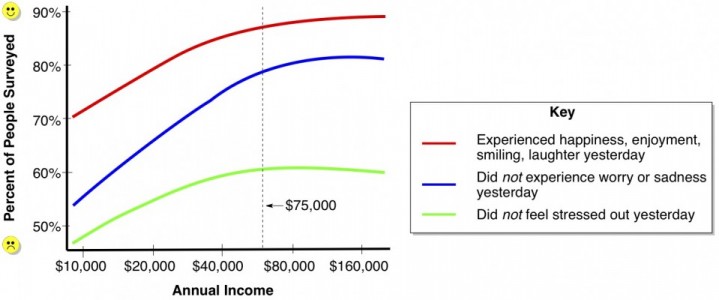
Rich people are happier than poor people
Richer countries are happier than poorer countries and
As countries get richer, they tend to get happier.
So the debate continues, and it's not clear if we can get an accurate and reasonably objective “cookbook” for happiness.
But here’s my advice, for what it’s worth…and in essence my gift for you on this Holy “eFFS-Mas”
Live and let live.
Don’t be afraid.
Make the world a better place than it was before you got here.
Do no harm and
Live your life to the top.