

No, not THAT Bobby Burns…the famed Scottish poet born on January 25th of the year 1759…no…this Bobby Byrnes, spelt “B-y-r-n-e-s” was a bartender from New York City by way of Beverly Hills who came to the town of Mashpee on the southern end of Cape Cod to create an “Eating, Drinking and Talking Establishment”, first opened in 1973.
His philosophy was as follows:
“We make the ordinary extraordinary by expressing each Pub in terms of art.
Our method, and indeed our madness, is using language and artifact to reveal the Pub’s soul.
To quote Seamus Heaney from his Nobel Lecture in 1995, we want to make use of “the energy released by linguistic fission and fusion,” and we want to tap “the power that reminds us we are hunters and gatherers of value.”
By celebrating language and artifact, we pray that our “pubsong” sings of the many thoughts and feelings that humans experience. We hope our display of language and artifact evokes a response in you….. That has its own plot and theme, its own structure, style, image, logo, rhythm and rhyme.
 We are at once surface and symbol.
It can speak to us of mystery, of beginning and end, of what is now and of what is to be. Like poetry, we touch upon the coherent and the unknowable at the same time. Thus the Pub is about more than food and drink. We want to give you magic and metaphysics with your meat and malt. We hope that we nourish your spirit and enable you to experience not only another great good place but also a great good thought.”
Okay, so that’s alot of Marketing Woo…but, interestingly enough: that really did describe what Bobby Burns meant to me. It was a place, like the fictional Cheers, where everybody knew your name…and every Thursday night, friends from all over, would assemble at a group of tables in the corner and talk through the night.
The Roman’s liked to say “In Vino Veritas”, in wine there is truth…and yes, at Bobby Burns there was alcohol involved, but despite our youth and complete lack of caution and common sense, (we were, afterall, immortals) we would eat, drink and be merry well into the early morning.
We discussed everything and anything: sports, theater, literature, sex, politics, religion, and each other. We’d tell each other stories of our lives, our plans for the future both near and far. It was a good mix of friends, reminiscent in a strange sort of way to Hemingway’s Lost Generation…without the pains of war.
We were students, and artists, scientists, engineers, chiefs, photographers, florists, musicians, actors, nurses, teachers, soldiers, body-builders and writers. I was the writer, as you might imagine.
- John was the actor.
- Dena and Dan were the artists.
- Heather was the nurse.
- Larry was the chief.
- Patty was the florist.
- Sean was the soldier
- Paul was the body builder
- Jim was the engineer.
- Diane was the photographer.
- Cheryl and Bob were the teachers
- And Dick, aka Dungman, aka Phinnias, was a mad spaz.
 Some of us were Catholic, others where protestant, one was Greek Orthodox and others were agnostic. We were liberals and conservatives, democrats and republicans, straight, gay and somewhere in-between…we didn’t always agree, but we loved each other “tree-si-so” and always had great conversations and arguments…and at the time, they were my best friends.
And Bobby Burns Pub, on a Thursday night, is where we all would meet.
That the name of my favorite Pub is also the name of one of my favorite poets is nothing more than a charming coincidence.
Robert B-u-r-n-s was born on January 25th, 1759 and left this mortal coil on July 21st, 1796 at the young age of 37.
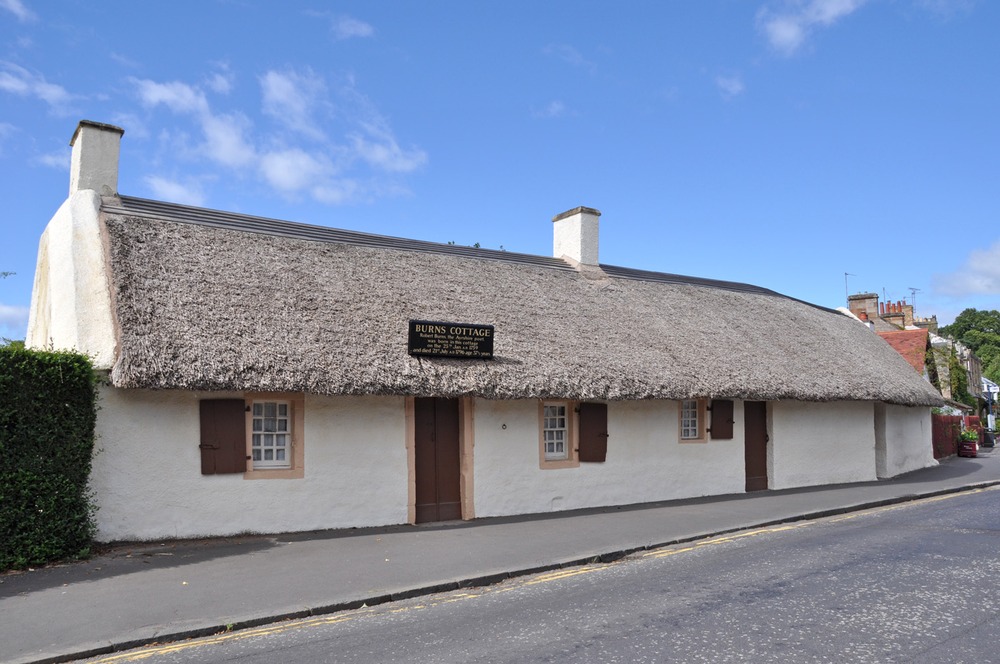
Robert was the oldest of 7 children. His father William was a tenant farmer who taught his children how to read and write. Robert attended school from 1763 through 1772, learning Latin, French, and mathematics.
By the time he was 15 years old, Robert was working as a laborer. During the harvest of 1774 he wrote his first poem:
O ONCE I lov'd a bonnie lass,
An’ aye, I love her still,
An’ whilst that virtue warms my breast
I'll love my handsome Nell.
As bonnie lasses I hae seen,
And mony full as braw;
But for a modest gracefu' mein
The like I never saw.
A bonny lass I will confess,
Is pleasant to the e'e;
But without some better qualities
She's no a lass for me.
But Nelly's looks are blythe and sweet,
And what is best of a',
Her reputation is compleat,
And fair without a flaw;
She dresses ay sae clean and neat,
Both decent and genteel;
And then there's something in her gait
Gars ony dress look weel.
A gaudy dress and gentle air
May slightly touch the heart,
But it's innocence and modesty
That polishes the dart.
'Tis this in Nelly pleases me,
'Tis this enchants my soul;
For absolutely in my breast
She reigns without control.

Of Peggy, he wrote:
"I met with my Angel.... It was vain to think of doing any more good at school. The remaining week I staid, I did nothing but craze the faculties of my soul about her, or steal out to meet with her; and the two last nights of my stay in the country, had sleep been a mortal sin, I was innocent. I returned home very considerably improved…"
He wrote two songs for Peggy Thompson, of which this is my favorite:
I dream'd I lay where flowers were springing
Gaily in the sunny beam;
List'ning to the wild birds singing,
By a falling crystal stream:
Straight the sky grew black and daring;
Thro' the woods the whirlwinds rave;
Tress with aged arms were warring,
O'er the swelling drumlie wave.
Such was my life's deceitful morning,
Such the pleasures I enjoyed:
But lang or noon, loud tempests storming
A' my flowery bliss destroy'd.
Tho' fickle fortune has deceiv'd me-
She promis'd fair, and perform'd but ill,
Of mony a joy and hope bereav'd me-
I bear a heart shall support me still.
In 1785, ten years later, Robert gave Peggy a copy of his poems with the following inscription on the inside titled “To an old Sweetheart”
Once fondly lov'd, and still remember'd dear,
Sweet early object of my youthful vows,
Accept this mark of friendship, warm, sincere,
Friendship! 'tis all cold duty now allows.
And when you read the simple, artless rhymes,
One friendly sigh for him - he asks no more,
Who, distant, burns in flaming, torrid climes,
Or haply lies beneath th'Atlantic roar.
Yes, Robert Burns was a romantic poet, with many of his themes focusing on the topic of love and love lost.
The third version of his 1791 poem and song, “The Banks O' Doon” is a perfect example of this:
Ye banks and braes o' bonie Doon,
How can ye bloom sae fresh and fair?
How can ye chant, ye little birds,
And I sae weary fu' o' care!
Thou'll break my heart, thou warbling bird,
That wantons thro' the flowering thorn:
Thou minds me o' departed joys,
Departed never to return.
Aft hae I rov'd by Bonie Doon,
To see the rose and woodbine twine:
And ilka bird sang o' its Luve,
And fondly sae did I o' mine;
Wi' lightsome heart I pu'd a rose,
Fu' sweet upon its thorny tree!
And may fause Luver staw my rose,
But ah! he left the thorn wi' me.
Every January 25th, on the anniversary of Roberts birthday, also known as “Burns Night”, a very special dinner is held, known of course as “Burns Supper”.
The first Burns supper was held in memoriam at the Burns Cottage by his friends on 21 July 1801, the fifth anniversary of his death,.
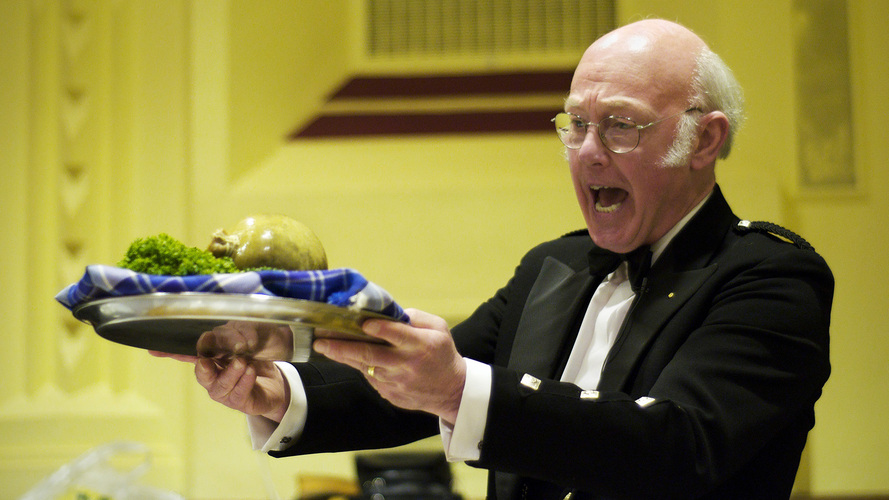
These suppers typically include haggis (a pudding-like dish made of minced sheep's heart, liver and lungs with onion, oatmeal, and spices encased in the sheeps stomach), Scotch whisky, and the recitation of Burns's poetry.
A bag-piper greets the guests, after which the host of the supper will give the Selkirk Grace:


Some hae meat an canna eat,
And some wad eat that want it;
But we hae meat, and we can eat,
And sae let the Lord be thankit.
The highlight of the evening, after a serving of soup, is when the Haggis is brought in, at which point everyone stands and the host will recite Roberts poem “Address to a Haggis” which I present to you in part:
Fair fa' your honest, sonsie face,
Great chieftain o' the puddin-race!
Aboon them a' ye tak your place,
Painch, tripe, or thairm:
Weel are ye wordy o' a grace
As lang's my airm.
The groaning trencher there ye fill,
Your hurdies like a distant hill,
Your pin wad help to mend a mill
In time o' need,
While thro' your pores the dews distil
Like amber bead.
His knife see rustic Labour dicht,
An' cut you up wi' ready slicht,
Trenching your gushing entrails bricht,
Like ony ditch;
And then, O what a glorious sicht,
Warm-reekin, rich!
Ye Pow'rs wha mak mankind your care,
And dish them out their bill o' fare,
Auld Scotland wants nae skinkin ware
That jaups in luggies;
But, if ye wish her gratefu' prayer,
Gie her a haggis!
At then, at the end of this reading, which is several stanzas longer than I’ve read here, a whisky toast will be given to the immoral memory of Robert Burns, the Lassies, and the Laddies.
The supper ends with some singing of Roberts songs and the reading of poetry, usually in honor of Scotland.
When the singing and poetry recital is over, the host or another guest will give a vote of thanks and everyone will stand, join hands and conclude the supper in song.
On Thursday nights, at Bobby Burns Pub in Hingham Massachusetts, my old friends and I would meet, usually at around 7 of the clock.

Some I lost touch with, a few revealed themselves to be sad sorry failures of humanity, some moved away from the east coast, others just followed a different path in life, and one of them, Sir Phinius of Spazbone, passed away from effing Cancer.
Those were some of the happiest days of my life; which isn’t to say that all my happy days are behind me…no. I live this life in full expectation of a happier future…but there was something very special about Thursday nights in my youth…something hopeful, joyful, and seemingly eternal.
It was the time in my life when I was entering adulthood, where everything I have become had it’s beginning: my career as a broadcast and network engineer, my affinity for producing audio content, my increased devotion to a certain Boston based Major League Baseball team, my love for gadget geekery, my self deprecating quirky humorous personality, my fascination with science and my founded fear of global warming.
35 years ago, we didn’t need much to enjoy our youth. A bottle and some good friends would often suffice. We’d talk about life, and love, our dreams and future plans and we’d laugh, joke and argue with each other well into the night.

I still talk about life, love my dreams and future plans…I guess I always will. And while Bobby Burns Pub no longer has an establishment in Hingham Ma, if you’re ever in Mashpee, Sandwich, or Hyannis..all on the Cape of Cod…raise a pint for the old times…raise a pint for the good times to come.
A Bottle And Friend
Written by Robert Burns
There's nane that's blest of human kind,
But the cheerful and the gay, man,
Here's a bottle and an honest friend!
What wad ye wish for mair, man?
Wha kens, before his life may end,
What his share may be o' care, man?
Then catch the moments as they fly,
And use them as ye ought, man:
Believe me, happiness is shy,
And comes not aye when sought, man.
Afterward
I have one last poem to read for you, from my good friend Bobby Burns.
It's a sad and desperate poem that I first read when I was a “young stranger with youthful pleasure raging and haply prest with cares and woes”.
By the time you hear this, I'll have celebrated my 55th orbit around the sun, and I'm looking forward to the 56th. It's going to be a bumpy ride this time around, hopefully no worse than past years…and I remain hopeful.
This is a poem meant to remind you of the obvious, as The Buddah said, "Life is Pain"...but you're not meant to leave it at that...because life is also immensely beautiful and amazing.
Man Was Made To Mourn: A Dirge
by Robert Burns
WHEN chill November's surly blast
Made fields and forests bare,
One ev'ning, as I wander'd forth
Along the banks of Ayr,
I spied a man, whose aged step
Seem'd weary, worn with care;
His face furrow'd o'er with years,
And hoary was his hair.
"Young stranger, whither wand'rest thou?"
Began the rev'rend sage;
"Does thirst of wealth thy step constrain,
Or youthful pleasure's rage?
Or haply, prest with cares and woes,
Too soon thou hast began
To wander forth, with me to mourn
The miseries of man.
"The sun that overhangs yon moors,
Out-spreading far and wide,
Where hundreds labour to support
A haughty lordling's pride;—
I've seen yon weary winter-sun
Twice forty times return;
And ev'ry time has added proofs,
That man was made to mourn.
"O man! while in thy early years,
How prodigal of time!
Mis-spending all thy precious hours—
Thy glorious, youthful prime!
Alternate follies take the sway;
Licentious passions burn;
Which tenfold force gives Nature's law.
That man was made to mourn.
"Look not alone on youthful prime,
Or manhood's active might;
Man then is useful to his kind,
Supported in his right:
But see him on the edge of life,
With cares and sorrows worn;
Then Age and Want—oh! ill-match'd pair—
Shew man was made to mourn.
"A few seem favourites of fate,
In pleasure's lap carest;
Yet, think not all the rich and great
Are likewise truly blest:
But oh! what crowds in ev'ry land,
All wretched and forlorn,
Thro' weary life this lesson learn,
That man was made to mourn.
"Many and sharp the num'rous ills
Inwoven with our frame!
More pointed still we make ourselves,
Regret, remorse, and shame!
And man, whose heav'n-erected face
The smiles of love adorn,—
Man's inhumanity to man
Makes countless thousands mourn!
”See yonder poor, o'erlabour'd wight,
So abject, mean, and vile,
Who begs a brother of the earth
To give him leave to toil;
And see his lordly fellow-worm
The poor petition spurn,
Unmindful, tho' a weeping wife
And helpless offspring mourn.
"If I'm design'd yon lordling's slave,
By Nature's law design'd,
Why was an independent wish
E'er planted in my mind?
If not, why am I subject to
His cruelty, or scorn?
Or why has man the will and pow'r
To make his fellow mourn?
"Yet, let not this too much, my son,
Disturb thy youthful breast:
This partial view of human-kind
Is surely not the last!
The poor, oppressed, honest man
Had never, sure, been born,
Had there not been some recompense
To comfort those that mourn!
"O Death! the poor man's dearest friend,
The kindest and the best!
Welcome the hour my aged limbs
Are laid with thee at rest!
The great, the wealthy fear thy blow
From pomp and pleasure torn;
But, oh! a blest relief for those
That weary-laden mourn!"
I’m Steve Runner, reminding you to Run long and Taper